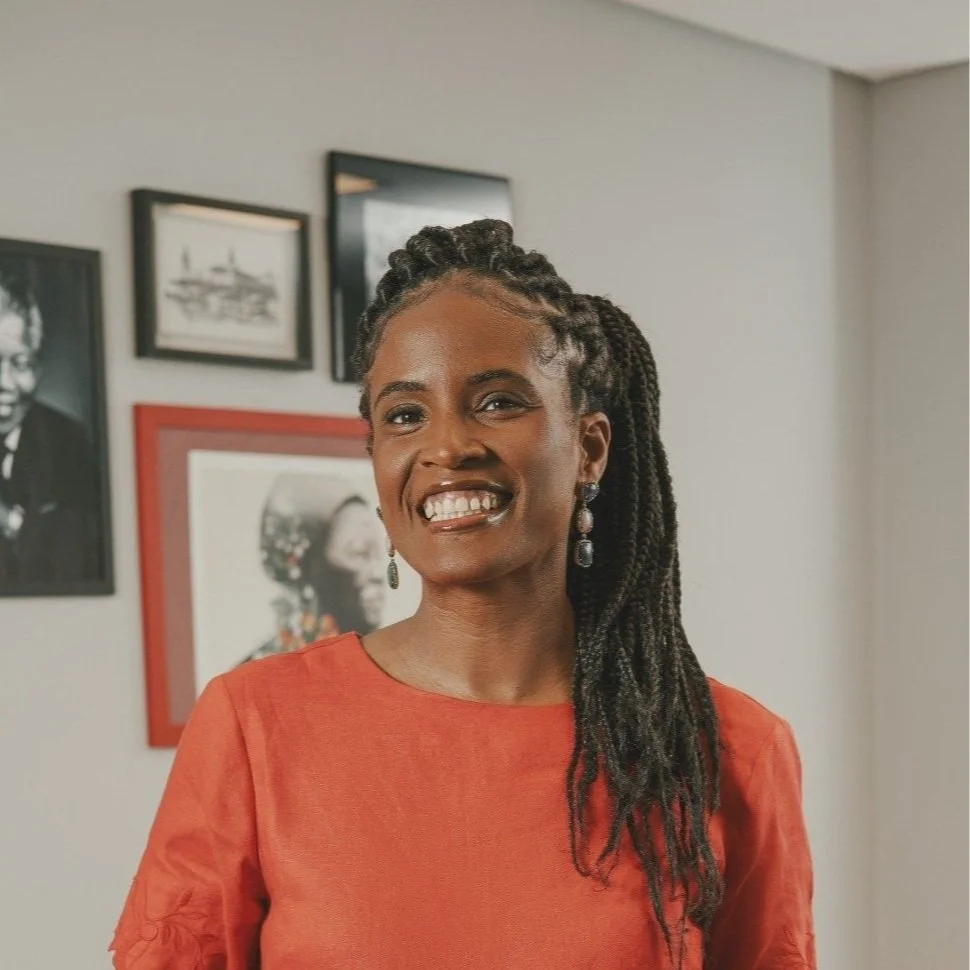
Djamila Ribeiro
MLK Visiting Scholar
Djamila Ribeiro has a Bachelor's degree in Philosophy and a Master's degree in Political Philosophy from the Federal University of São Paulo. She is the coordinator of the Plural Feminisms Collection and founder and president of the Plural Feminisms Institute. Ribeiro is a columnist for Folha de S. Paulo and an author who has sold more than 1 million copies; she was formerly a professor at Pontifícia Universidade Católica de São Paulo and also a visiting professor at New York University. Ribeiro is the first Brazilian to be invited by MIT as part of the MLK Visiting Professors and Scholars Program. An award-winning intellectual, she was named by the BBC as one of the 100 most influential women in the world and was a laureate of the Franco-German Human Rights Prize.
“Knowledge is never neutral”
Scholar, philosopher, activist, and Visiting MLK Scholar Djamila Ribeiro researches and writes about making space for underserved and marginalized people.
Visiting MLK Scholar Djamila Ribeiro investigates the structural dimensions of racism and discriminatory practices in the Global South. Her research focuses on challenges unique to the Black family and epistemologies of the Global South. Her work situates current trends and traditions affecting these populations, ideas, and related challenges within their historical and socioeconomic contexts.
The north/south divide, Ribeiro asserts, privileges and centers northern thought and ideology while simultaneously devaluing southern thought and ideology (when they’re acknowledged at all). Her work aims to reorient that calculus, working to overcome the epistemic exclusion – a scholarly devaluation where a researcher's work is dismissed or undervalued due to identity-based biases and disciplinary biases about what knowledge is legitimate – at the heart of the policies and practices impacting the South’s inhabitants.
“There is a geographic dimension to the Global South,” she notes, “but the divide between the Global North and South is also ideological and political.”
Democratizing knowledge instruction is a key element of her work, as is deconstructing racial and gender-based hierarchies, whose impacts influence everything from pedagogy to public policy. “Knowledge is never neutral,” she says. “It’s important to lend legitimacy to knowledge and scholarship produced in the Global South.”
The university professor – she’s currently working at the Pontifical Catholic University of São Paulo and was previously a guest lecturer at New York University – is the coordinator of the Plural Feminisms initiative. She is also a renowned author and scholar in Brazil and elsewhere. She wrote “Where We Stand,” the book Service 95 described as “the book that mainstreamed Black feminism in Brazil” and the Los Angeles Times featured in a “10 books to add to your reading list” piece, “Who is Afraid of Black Feminism,” “Little Antiracist Manual,” and “Letters to my Grandmother.”
Ribeiro holds a bachelor’s degree in Philosophy and a master’s degree in Political Philosophy from the Federal University of São Paulo (UNIFESP).
Creating inclusive spaces for scholarship
Ribeiro’s work as an activist and writer began as a child in Brazil. “I grew up in Santos, Sao Paulo, Brazil as a member of a Black working-class family,” she recalls. “My father was part of Brazil’s Black Liberation Movement. I was born into an environment that centered on liberation and lifting up those who couldn’t speak for themselves.”
Ribeiro’s work and scholarship are heavily influenced by her working-class roots. Her time at a nongovernment organization (NGO) operated by Black women during her formative years in Brazil shaped the scholar she would later become. “While working at the NGO, I learned firsthand about these women’s abilities,” she says. “It fed a political and intellectual awakening.”
Ribeiro is part of a generation of Black Brazilians who became first-generation college graduates due, in part, to programs enacted by former President Luiz Inácio Lula da Silva. Her work writing about race and gender for Brazilian newspapers and magazines continued her intellectual growth while shaping her ideas and acumen.
“My activism advised my experiences,” she says. It also created a fierce advocate for intellectuals, authors, and others whose stories previously went untold. “We’ve made a difference in Brazil’s literary landscape; more publishers are publishing Black authors.”
Expanding the pool of texts available for review and study animates Ribeiro’s work. She wants to see more books translated into English, as hers were. “The U.S. only translates three percent of international publications into English annually,” she notes.
Ribeiro arrived at MIT by invitation of Joaquin Terrones, a lecturer in MIT’s Literature Section and the Program in Women’s and Gender Studies. Ribeiro describes him as “concerned about my work and my wellbeing.”
I was thrilled to receive the invitation,” she enthuses. “Our conversations about my research and outcomes showed me there were opportunities to expand their reach and collaborate with a collective of like-minded individuals at MIT.
Terrones explains: “I nominated Djamila for the MLK Visiting Scholars program because her incisive analysis of racism and sexism and her unwavering commitment to making scholarship accessible to broad audiences has positioned her as one of Brazil's most vital and influential public intellectuals.”
“I always want to write in a way that my mother would understand,” she said during a New York Times interview. “I felt a calling to be generous enough to write in the same accessible way that generous authors before me wrote, because otherwise you only legitimize the power spheres of those who are privileged.”
Life as an academic
As she continued exploring life among marginalized peoples, Ribeiro discovered serious challenges related to her research and investigations. “I learned that academia in Brazil wasn’t designed for this kind of exploration,” she says. “Professors weren’t grounded in or experienced with Black feminism, African scholarship, and philosophy.”
Ribeiro’s study as a philosopher helps her deepen an understanding of phenomena she’s experienced practically and politically. She’d like to work with institutions like MIT to create those kinds of opportunities for scholars in Brazil and the Global South. She hopes to prevent the kinds of erasure that can limit scholars’ reach and reduce opportunities for collaboration.
Upon arriving at MIT, Ribeiro discovered a vibrant community of scholars invested in helping her succeed. “I’m the first Brazilian to be part of this program and hope I’m not the last,” she says. “Working with scholars in the Women’s and Gender Studies program, the Data Lab, and elsewhere is helping build a valuable bridge between Brazil and America.”
“I can refine my theoretical frameworks in dialogue with global leaders,” she says, praising opportunities to work with people at MIT and elsewhere focused on social justice. “The vibrant intellectual community available to me at MIT is welcome and exciting.”
Present challenges and opportunities for future solutions
The academy and its institutions, Ribeiro notes, act as arbiters of knowledge and its value. By creating opportunities for other voices and expanding the reach of their scholarship, she believes institutions and organizations can benefit.
“My work as an academic is improved by my work as an activist,” she argues. “It’s important to design opportunities for idea production that include marginalized and seldom-heard voices.”
Ribeiro is keenly aware of the challenges presented by AI’s growth and influence, challenges she argues are worse for people from marginalized communities. “AI can reinforce structural inequality,” she says, noting that the technology can be seen as exploitative. She’s wary of AI’s impact on what she calls “epistemicide,” the exclusion and destruction of knowledge produced by marginalized communities.
“Who programs and produces the data AI uses?” she asks. “Who benefits from its continued growth?” It’s important to remove barriers to access for people from across the world to reduce bias, ensure AI’s equitable and effective use, and promote connectivity and inclusive practices.
Connections with other activists and scholars created valuable opportunities for Ribeiro and others like her. Sharing space with folks outside academia helps improve the quality of her research and related outcomes. “I fought to study what I wanted to study,” she says, advocating for opportunities to get new and exciting ideas from outside traditional research areas.
“My work helps people understand who gets to speak, who is believed, and who is ignored,” she believes. “When exclusion becomes normalized, it informs how social groups shape political systems, influence jurisprudence, frame public debate, deliver healthcare, and share technology.”
Ribeiro wants to expand existing definitions of knowledge, overcome barriers to entry for non-English speakers in the Global North’s research and academic areas, and expand the production of and access to Brazilian voices. “Listening is a political act,” she says. “We’re producing interesting things in our country.” Ribeiro wants to improve the exchange between the Global North and South while broadening access to the global marketplace of ideas for members of underserved and marginalized communities.